
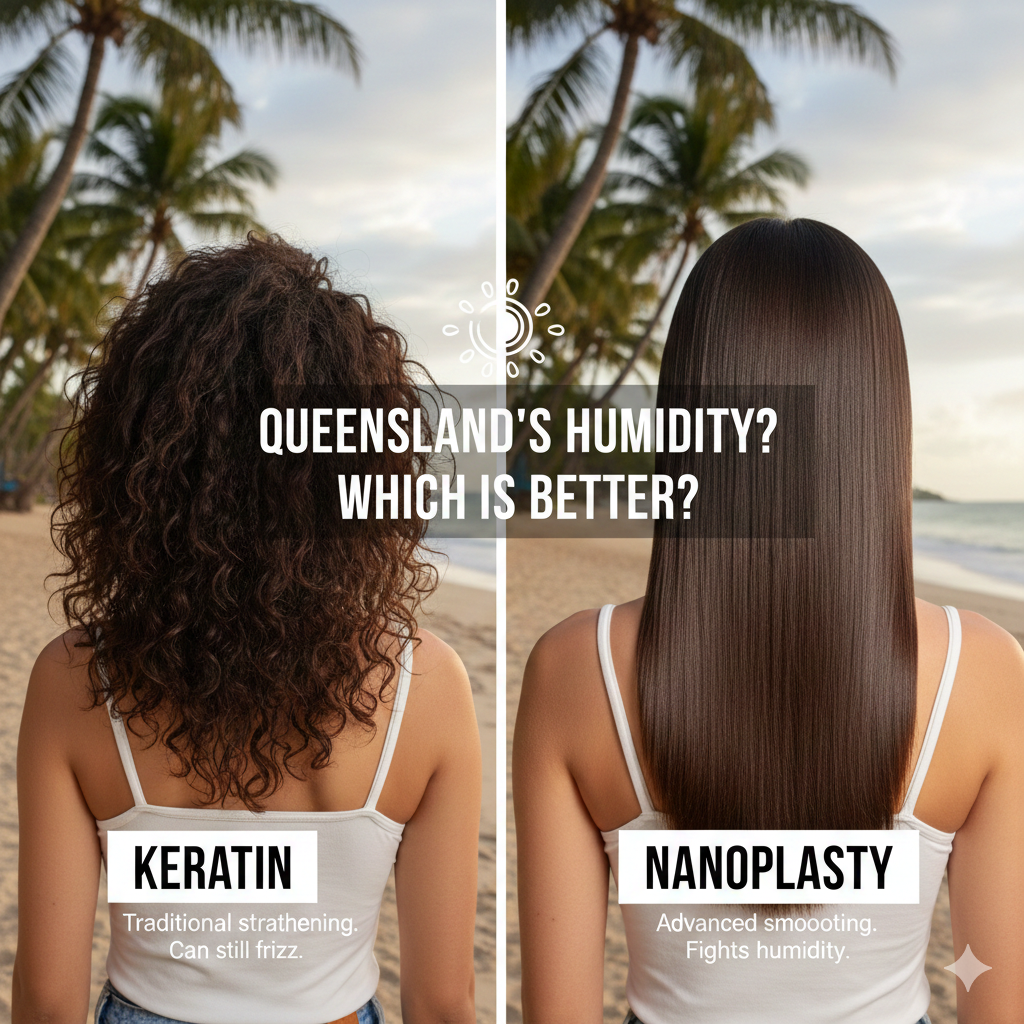
If you live anywhere around Brisbane Southside, Logan City, Hillcrest or Browns Plains, you already know the drill. Your hair looks perfect when you leave the house. Twenty minutes later, the humidity’s got other plans.
With humidity sitting between 65% and 90% for most of the year in South East Queensland, it’s no surprise that “keratin vs nanoplasty” is one of the questions we get asked most at Hair Hub Hillcrest. Both treatments smooth and de-frizz the hair, but they don’t work the same way, and they definitely don’t perform the same way once you step outside into QLD’s climate.
This guide breaks down what each treatment actually does, how they compare head-to-head, and which one is the better fit depending on your hair type and lifestyle.
Why Queensland’s Climate Makes This Decision Harder
Smoothing treatments that work brilliantly in Melbourne or Sydney don’t always hold up here, and that comes down to how our climate interacts with hair structure.
Humidity keeps the hair cuticle open
When the air is thick with moisture, the outer layer of the hair (the cuticle) lifts and lets moisture in. That’s what causes hair to swell, frizz, and revert back to its natural texture, no matter how smooth it looked that morning.
Heat speeds up how fast a treatment “gives up”
Every smoothing treatment fades eventually. But how quickly depends on how deep the treatment actually penetrates the hair, and how resistant your natural curl or wave pattern is to begin with.
UV exposure wears down surface treatments faster
Queensland sun is relentless, and that matters here because surface-level coatings break down faster under UV, sweat, chlorine and saltwater than treatments that work from within the hair shaft.
Which Treatment Is Right for You?
Want expert help choosing between keratin and nanoplasty?
Still unsure whether Keratin or Nanoplasty is the best option for your hair? Book a personalised consultation with our Hair Hub Hillcrest team, and we’ll recommend the right treatment based on your hair type, goals, and lifestyle.
What a Keratin Treatment Actually Does
A keratin treatment works by coating the hair shaft with keratin protein and sealing it in with heat. It smooths the surface and calms frizz, but it doesn’t change the internal structure of the hair.
Where keratin shines:
- Reducing frizz and softening waves
- Adding shine and making hair easier to style
- Keeping some natural movement and volume
- Working gently on coloured or fine hair
Where it falls short:
- Very curly or coarse hair won’t come out fully straight
- Longevity is shorter, especially in QLD’s summer humidity
- Not the best option if you want 6+ months of results
What Nanoplasty Actually Does
Nanoplasty is the newer, more advanced option. Instead of just coating the hair, it uses nano-sized molecules that get into the cortex, restructure the internal bonds, and reseal the cuticle from the inside out.
Where nanoplasty shines:
- Strong resistance to humidity, even in 80–90% conditions
- Noticeably straighter, sleeker results
- Repairs damage while it smooths
- Best suited to thick, coarse, curly or chemically treated hair
Where it falls short:
- Can flatten fine hair more than some clients want
- Longer appointment time
- Not ideal if you want to keep a natural, bouncy finish
Keratin vs Nanoplasty: Side-by-Side Comparison
| Factor | Keratin | Nanoplasty |
|---|---|---|
| How it works | Coats the hair shaft | Restructures internal bonds |
| Frizz control in QLD humidity | Good, fades faster in summer | Excellent, holds up in high humidity |
| Straightening power | Softens curls | Can achieve up to 80–100% straightening |
| Longevity | 2–4 months | 6–9 months |
| Treatment time | 1.5–2.5 hours | 3–5 hours |
| Best for | Wavy, fine-to-medium, coloured hair | Thick, coarse, curly or damaged hair |
| Finish | Natural, soft, with movement | Sleek, straight, glass-like |
So Which One Actually Wins in Queensland’s Humidity?
Being honest with you: nanoplasty tends to hold up better through a Brisbane summer. It penetrates deeper, rebuilds the hair from the inside, and simply resists moisture more effectively than a surface coating can.
That doesn’t mean keratin is a bad choice, though. It comes down to what you actually want from your hair.
Go with keratin if you want:
- A natural, soft finish rather than pin-straight hair
- To keep some volume and movement
- A shorter salon visit
- A gentler option for coloured hair
Go with nanoplasty if you want:
- Hair that survives a humid Queensland summer without frizzing
- Noticeably straighter results that last
- Deep repair for damaged or over-processed hair
- Fewer touch-ups throughout the year
How to Decide What’s Right for You
A few honest questions to ask yourself before booking:
- How curly or coarse is my natural hair?
- Do I want a natural look, or a sleek, straight finish?
- Am I okay with a longer appointment for longer-lasting results?
- How much does Queensland humidity actually affect my hair day-to-day?
If you’re still not sure, that’s exactly what a consultation is for. Our stylists at Hair Hub Hillcrest look at your hair type, density and lifestyle before recommending either treatment, rather than pushing one over the other.
What Our Clients Say
Client Reviews
“Nanoplasty held up even during summer storms.”
“Keratin gave me smoothness without losing my wave.”
“Humidity doesn’t ruin my hair anymore — finally!”
Is keratin or nanoplasty safer? Both are safe when done by a trained stylist. Many nanoplasty formulas used in salons today are aldehyde-free, which some clients prefer.
Which one lasts longer in Queensland’s humidity? Nanoplasty typically lasts 6–9 months, while keratin lasts 2–4 months before you’ll need a touch-up.
Can keratin straighten curly hair completely? Not fully. It softens and relaxes the curl pattern but won’t give you a pin-straight result the way nanoplasty can.
Will nanoplasty make my hair too flat? It can reduce volume noticeably on fine hair, so it’s worth discussing your hair density with your stylist first.
Is nanoplasty better for thick or Asian hair textures? Generally yes, because it restructures the internal bonds rather than just coating the surface, which holds up better on denser hair types.
Does keratin work on coloured hair? Yes, and it’s often a gentler option for colour-treated hair that needs extra smoothness and shine.
Can I switch from keratin to nanoplasty later on? Yes, plenty of clients do. Just make sure treatments are spaced out appropriately, which your stylist can advise on.