
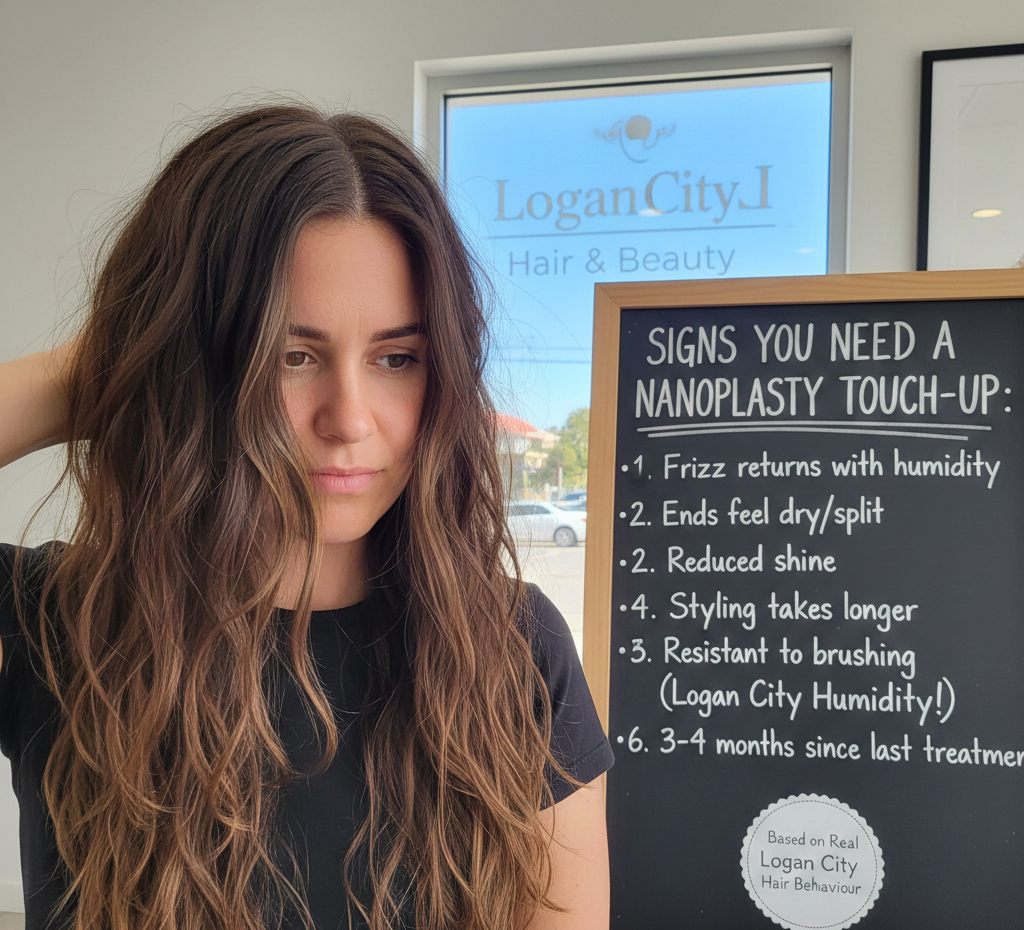
If you live around Logan City, Browns Plains, Hillcrest, or Brisbane Southside, you already know the hair reality here: even the best smoothing treatment can eventually begin to soften under Queensland’s humidity. Nanoplasty lasts significantly longer than keratin — often 6 to 9 months — but no smoothing treatment is completely permanent.
What does change with nanoplasty is how the hair behaves over time. Unlike keratin, which wears away from the outside, nanoplasty restructures the hair from within. That means it doesn’t “fade” — instead, new growth appears, humidity causes behavioural changes, and the treated lengths slowly lose rigidity.
But here’s the question most women ask:
“How do I know when it’s actually time for a touch-up?”
This guide breaks down the real-world signs based on the hair behaviour we see daily in Logan City, from thick Asian hair to coarse curls to long, frizzy hair that absorbs moisture instantly. If you’ve had nanoplasty in the last few months and your hair is starting to “act different,” these are the signs worth paying attention to.
Why Hair Behaves Differently in Logan City After Nanoplasty
Before looking at signs of reversion, it helps to understand why Queensland’s environment plays such a major role.
Humidity Keeps the Cuticle Slightly Lifted
When humidity sits at 60–90% — which is normal in Logan and Browns Plains — moisture enters the hair fibre more easily. Even nanoplasty-treated hair can begin to:
- swell slightly
- feel heavier
- lose that “sealed” finish
- take longer to smooth after washing
This isn’t failure. It’s normal moisture behaviour.
UV + Heat Exposure Softens Treated Hair Over Time
Nanoplasty is more UV-resistant than keratin, but extended exposure:
- long school pick-ups
- outdoor work
- weekend markets
- summer driving
…slowly weakens the rigidity that the treatment created inside the cortex.
New Growth Is the #1 Indicator
Nanoplasty does not stop your hair from growing. New hair = untreated hair.
As this new growth gets longer, you’ll start to see a difference in:
- texture
- volume
- curl pattern
- frizz level
The bigger the contrast, the more likely it’s time for a touch-up.
The 12 Real Signs You Need a Nanoplasty Touch-Up (Logan City Edition)
These are based on real client behaviour — the same patterns we see every week at Hair Hub Hillcrest.
1. Your Roots Start to Feel Puffy or Raised
The first sign is rarely visible — you feel it before you see it.
Women describe it as:
- “extra height at the roots”
- “more lift than I want”
- “my hair doesn’t sit flat anymore”
This usually appears 8–12 weeks after nanoplasty as untreated new growth becomes long enough to influence the overall shape.
2. Frizz Returns in Specific Patches — Not Everywhere
Humid pockets like Logan and Browns Plains make frizz appear first:
- around the crown
- hairline/temples
- behind the ears
- at the nape
This is partial reversion, not failure. It’s the new growth reacting to moisture.
3. Your Hair Takes Longer to Smooth When Blow-Drying
Early nanoplasty results = instant smoothness.
Later-stage behaviour = you need:
- 2–5 extra minutes
- more directional blow-drying
- more tension at the brush
If drying time increases gradually, it’s your hair signalling that internal rigidity is softening.
4. Rain or Sweat Reverts Your Hair Faster Than Before
Logan humidity + school runs + gym workouts = a perfect test.
If your hair:
- absorbs moisture quickly
- starts to puff during sweat
- loses its sleekness within an hour
…it’s time for a top-up.
5. Your Ends Still Look Smooth, but the Mid-Lengths Don’t Match
Nanoplasty always lasts longest in the ends.
When only the mid-shaft begins to show resistance or texture, it means the treated structure is softening — not that the treatment failed.
6. The Shine Isn’t as Reflective as Month 1–3
Shine reduction doesn’t mean damage.
It simply means:
- the cuticle is not lying as flat
- humidity is interfering with reflectivity
- the nano-repair is softening
A touch-up restores that mirror-like finish.
7. You Need More Styling Product Than Before
Especially smoothing creams or oils.
If you’re using:
- double the product
- products you didn’t need in months 1–3
…it’s a behavioural marker of reversion.
8. Your Natural Curl or Wave Pattern Begins Reappearing
This is common for:
- Asian hair
- coarse hair
- mixed-texture hair
- thick frizzy hair
You won’t see full curl return — more like a “memory” of movement in the roots.
9. The Weather Impacts Your Hair More Than It Did Earlier
If rain, mist, or humidity bothers your hair again, the internal structure is losing some resistance.
10. Your Hair Feels Lighter or Fluffier
Nanoplasty gives a controlled, weighty smoothness.
When that changes, the seal has softened.
11. Your Ponytail Starts Expanding Throughout the Day
Clients describe it as:
- “my pony gets thicker again”
- “it’s not staying sleek”
- “the surface gets fuzzy”
This is one of the clearest signs.
12. The 6–9 Month Timeline Is Approaching
Even if your hair looks good, nanoplasty is structural — not just cosmetic.
Touch-ups:
- strengthen the previous treatment
- prevent reversion
- keep humidity resistance strong
- maintain internal fibre alignment
Most Logan clients find the sweet spot is every 6–7 months, not waiting the full 9.
Micro-Story: “My Hair Looked Fine… Until I Walked Outside”
Natasha, a Loganlea client, shared this during her second nanoplasty consultation:
“Inside, my hair seemed okay. But the moment I stepped out to get the kids from school, the roots started lifting again. That’s when I realised the ends were still smooth — but the new growth was ruining everything.”
This is one of the most common experiences in Queensland’s humidity.
When a Touch-Up Is Not Needed Yet
To avoid unnecessary treatments, here’s what does not mean reversion:
✔ Your roots feel slightly warm after blow-drying (normal)
✔ Your hair feels too soft (nanoplasty smooths deeply)
✔ Your blow-dry lasts 2–3 days
✔ Your hair still fights humidity well most days
If your hair still passes those checks, you may not need a touch-up yet.
How to Make Nanoplasty Last Longer in Logan City
1. Reduce UV Exposure (QLD sun is extreme)
Hats, scarves, or UV-protecting sprays help.
2. Use sulphate-free products
This prevents cuticle disruption.
3. Avoid washing daily
Every wash softens the rigidity faster.
4. Use heat protectant every time
Even for straightening iron touch-ups.
5. Keep sweat off your roots when possible
Hot yoga, summer gym sessions, and running accelerate moisture absorption.
6. Maintain trims every 10–12 weeks
Prevents fraying, which reduces definition.
Client Reviews
“My nanoplasty lasted eight months, even through Logan’s storms.”
“The first sign for me was puffiness at the roots — the mid-lengths still looked amazing.”
“Touch-ups every 6 months give me perfect, stress-free hair.”
APPOINTMENT-ONLY CTA
If you’re unsure whether you truly need a nanoplasty touch-up, we can analyse your hair’s behaviour, new growth, and humidity response.
Hair Hub Hillcrest is an appointment-only salon, ensuring every smoothing consultation is personalised, detailed, and tailored to Queensland conditions.
📞 Call
💬 WhatsApp
🖥 Book Online
FAQs
1. How long does nanoplasty last in Queensland humidity?
Typically 6–9 months, depending on hair thickness, washing frequency, sun exposure and humidity sensitivity.
2. Does nanoplasty fade like keratin?
No. Nanoplasty restructures bonds, so it softens gradually instead of “wearing off.”
3. What does nanoplasty reversion look like?
New growth, patchy frizz, slower blow-drying, and a mild return of texture.
4. Is nanoplasty better for Asian or coarse hair?
Yes — these hair types respond extremely well because of their density and structure.
5. Is it safe to repeat nanoplasty?
Yes. Each touch-up reinforces the previous treatment.
6. Can I colour my hair before a touch-up?
Yes, but ideally 1–2 weeks before nanoplasty.
7. Does humidity break nanoplasty?
No — but it can reveal new growth sooner.
8. How do I know if I should wait instead of redoing it?
If the ends still look sleek and humidity resistance is strong, you may not need a full treatment yet.
9. Can I switch from keratin to nanoplasty?
Absolutely — many Logan clients do this for better humidity protection.
10. What’s the ideal nanoplasty maintenance schedule?
Every 6–7 months works best for most women in Logan City and Browns Plains.